
|
|
Measuring Progress
By Chad Tackett
|
|
|
Success can be measured on a number of levels. It's important
to measure your progress by the new healthy habits you're
adopting as well as by your appearance. Long-term decreases
in medical problems, injury, and other health risks and
an improved quality of life, with or without weight loss,
are the most important measures of success.
Short- and medium-term changes can also be measured regularly
during the process. These include obvious changes in health-related
behavior patterns such as a decreased reliance on medications,
increased ability to perform physical activity, a reduced
intake of fat, and the increased intake of dietary fiber,
vitamins, and minerals in your diet.
If you've started making slight changes in how your food
is cooked or prepared, or if you're reading labels at the
grocery store and are discovering new tastes and textures,
you're making great improvements towards a healthier lifestyle.
When you feel good about yourself and acknowledge the changes
you're making along the way, you're more likely to keep
moving forward on your path.
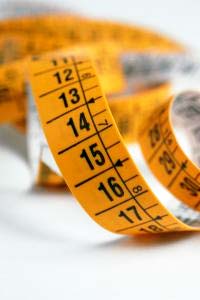
Physical indicators of progress towards a healthier body
fat distribution include the waist circumference and waist-hip
ration (WHR). Because abdominal obesity has consistently
been associated with risk factors for diabetes and heart
disease, any reduction in the waist circumference or in
the WHR is a positive step towards a healthier body fat
distribution, regardless of weight loss.
Another good way of determining physical progress is having
your body fat measured by either hydrostatic weighing, electrical
impedance, or simply by using skinfold calipers. This latter
is by far the cheapest and most accessible. Although it
is not as accurate as the other two methods, it can at the
very least give you a beginning point from which you can
easily measure decreases in body fat. Please refer to the
Global Health and
Fitness Personal Trainer Directory (www.global-fitness.com)
to find a certified personal trainer in your area that can
measure your body fat percentage.
|
|
|
|
BB4U Recommends: Pete Sisco's Maximum Strength |
Pete Sisco is the developer of Power Factor Training and Static Contraction Training - over 200,000 people worldwide have trained using Pete's methods.
In just 10 weeks of Static Contraction training, trainees (hardcore bodybuilders who had been lifting "heavy" for a long time and averaged 38years old) achieved the following average gains:
- 51.3% increase static strength
- 27.6% increase in one-rep max in full range of motion! (without doing full range lifts for 10 weeks!)
|
|
- 34.3% increase in ten-rep max in full range of motion! (see above)
- gained 9.0 pounds of new muscle (one subject gained 29 pounds of muscle!)
- gained 1/2 inch on each biceps, 1.1 inches on chest, and 1.2 inches on shoulders
- lost 4.9 pounds of fat & lost 0.4 inches on waist
Have you had size and strength gains like the above in the last 10 weeks? With Pete's no-nonsense, scientific approach to bodybuilding and strength training you can achieve your goals and go beyond.
>> Click here for Pete Sisco's Maximum Strength Program << |
|
However you decide to measure your physical progress, never
use the scale as an indicator. Your weight does not reflect
how healthy you are or the progress you've made. When you
step on the scale, your weight reflects the combined total
of both your lean body weight (muscle, bone, organs, fluids)
and body fat weight. Two people with identical body weights
do not have the same body composition; they could, indeed,
have entirely different body types. For example a 170-pound
man might have 60 pounds of body fat and 110 pounds of lean
body mass. A healthier, more muscular man might only have
25 pounds of body fat and 145 pounds of lean body mass.
Even though these two individuals weigh the same, one is
in much better shape than the other.
Using the scale to measure your progress gives you no information
about the body composition (fat vs. muscle) changes that
are actually occurring. The scale may show that you've lost
seven pounds, but it can't tell you that half of the weight
was muscle and water, not fat. Similarly, people become
discouraged when they haven't lost any weight, even though
they have actually lost pounds of fat and replaced them
with pounds of firm, fat-burning muscle.
Developing healthier eating and physical activity habits
will most likely result in a loss of body fat even though
the scale may indicate that you weigh the same. Learn to
use other methods of determining body composition and pay
more attention to improvements in how you feel, in your
self-esteem, and in your physical appearance.
Height/weight charts and other tables such as the BMI (Body
Mass Index: weight in kilograms divided by height in meters,
squared) have similar limitations when used as an indicator
of progress towards a healthier lifestyle for several reasons.
First, these formulas are not always related to how fat
you are since they don't take into account body composition/fat
distribution. Many people who are muscular or short and
stocky have a high BMI, even though they are not necessarily
fat or at high risk for disease. Second, the BMI is only
appropriate for adults 20-65 years of age. It cannot account
for patterns of growth in adolescents or in the elderly,
who may decrease in height with age. Third, the focus is
still on changing one's weight to produce a lower BMI (since
it's not possible to increase one's height). This continues
to promote weight change as the ideal way to improve health.
Don't forget to notice and acknowledge improvements in
energy, performance, self-esteem, and the many other benefits
you'll gain from this healthier lifestyle: improvements
in health risk factors and medical conditions, improved
quality of life and psychological functioning, healthier
eating, and more enjoyable physical activity. Good luck:
I hope you enjoy all the wonderful benefits of a healthy,
active lifestyle.
>>
Click here for the Global Health and Fitness Program

>> Click here for a free 2 week workout plan with 27 essential exercises for strength training e-book from Global Fitness
|
|
|
|
About Global Health and Fitness
Want to finally achieve your fitness goals? Global-Fitness.com provides you with customized exercise and diet plans, hundreds
of exercise instructions and video demonstrations, fitness
tracking software, personal expert advice from 30 world-renowned
fitness, medical, and nutrition experts, FREE calorie, fat,
protein, and carb calculators, and much more!
Global-Fitness.com has helped thousands of men and women of all ages, fitness
levels, and backgrounds to look, feel, and perform at their
very best! Whether you are a beginner or advanced, they'll
help you avoid the common mistakes that waste your time,
teach you techniques for making your routine much more effective,
and guide you step-by-step to achieving new results again
and again!
|
|
|
Bowflex & Total Gym Home Gym |
|
Bowflex Ultimate Home Gym
The Bowflex Ultimate 2 Home Gym is a total-body solution that delivers everything you could possibly imagine for great fitness results. It offers 95 exercises and includes a lat tower, leg extension/leg curl station, preacher curl attachment, integrated squat station and more. Click here for the BowFlex Ultimate 2 |
|
Bowflex Revolution Home Gym
The Bowflex Revolution home gym comes with over 100 exercises with a built-in cardio rowing workout. It includes preacher curl attachment, 5 position foot harness, hand grips, leg press plate, instructional manual, and much more Click here for the Bowflex Revolution |
|
Total Gym Home Gym With Total Gym, you target all major fitness areas with just one workout: resistance training, cardio training and stretching. Everything your body needs on just ONE machine.
>> Click here for Total Gym - As Seen on TV with Chuck Norris & Christie Brinkley. 10% OFF with Promo Code: 11001 |
|
|
|
|
|
|