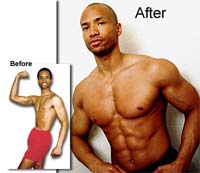
 WHY CAN'T YOU GAIN WEIGHT?
Without a plan and a specific goal you will be without focus and can easily get lost or side tracked. This happens more often than you know. I see many people in the gym just doing whatever, or just eating whatever -- no plan or specific goal. They wonder why they don't make progress. They have no focus.
Having a specific program to follow allows you to take action each day. This action is focused on specifically getting you to your destination quickly. There is no thinking, debating or guessing. You just do it. A specific plan provides necessary daily structure that not only keeps you on the road moving forward, it also helps to develop good eating and training habits that will benefit you long after you have reached your destination.
3.Have confidence in yourself and belief in what you are doing.
Let’s face it; we live in a cruel world. Hate and jealously is everywhere. For most people who begin a fitness program to improve themselves, getting started will be half the battle. The other half will be staying motivated throughout the constant onslaught of negativity from others. A few negative words can do serious damage if you allow it.
The most insulting things you hear may be from friends, co-workers and acquaintances at the gym. People hate change. It makes them insecure, because they suddenly discover there’s more to you than they were probably willing to admit. They fear that you may actually achieve your goal. It makes them look less “superior”.
Once you have begun your plan, you must have faith and believe in what you are doing. Stay focused and avoid overly critical or negative people. If you have to, keep your business to yourself. When I first began my program, I stopped talking about what I was doing because I got tired of hearing things like “you can’t do that”, “that’s impossible”, “you’re wasting your time and money”. Funny thing is, now those people are constantly bugging me for advice.It’s your life. It’s your body. It’s your dream. Don’t allow your success or failure to rest in the hands of others.
>> Click here to learn more about Anthony's Weight Gain Program
WORKOUT RULES
4. Stop listening to every ridiculous piece of advice you hear in the gym.
Recently a client of mine informed me that someone in the gym stated that he was training all wrong and he needed to train 5-6 days a week, and aim for more reps during his workout. Somewhere in the range of 15-20 reps per set.
The person giving the advice was quite confident about his recommendations, and he had an impressive physique that typically elevates him to the elusive "listen to me if you want to look like me" level in the gym. He was bigger than my client, so even though my client's "intellectual" mind knows that that advice is absurd; his "unrealistic dreamer" mind took this information very seriously. So seriously that he changed his program and didn't inform me until a week or so later. This particular person had been making great progress on his current program, yet he allowed this one person’s comment to overshadow that progress and convince him that his program was inadequate. This is a mistake and it showed in his lack of further progress.
In addition, don't judge the validity of what a person says by how they look. Just because the guy is huge doesn't mean he is spewing pertinent advice for you. Many people that have big physiques are big despite of their training, not because of it. I know some huge guys that know very little about training and dieting correctly. They can do whatever and still gain muscle; unfortunately we are not that way, so we much approach things in a more intelligent way.
5.Workout Infrequently
This is the most difficult concept for many to grasp simply because it involves less action, instead of more. When we get motivated and start a new program, it’s natural to want to do something. We want to train and train and train. Thinking all along that the more you train, the more muscle you will build. Unfortunately, this could not be farther from the truth.
More training does not equal more muscle growth. Understand that the purpose of weight training is to stimulate muscle growth. That takes very little time. Once that has been done, the muscle needs to be repaired and new muscle needs to be built. That only happens when you are resting. You do not build muscle in the gym, you build muscle when resting! If you never give your body any essential “non active” time, when will it have a chance to build muscle? Think about that.
Now, add in the fact that you have a difficult time gaining weight and the importance of rest increases. Individuals who are naturally thin and have difficulty building muscle tend to require less training and more rest.
6. Focus on Multi-Jointed Lifts
Multi-jointed exercises are those that stimulate the most amounts of muscle fibers. Unlike isolation exercises which only work individual muscles, multi-jointed lifts work many different muscle groups simultaneously. For those needing to gain weight, this is ideal because these lifts put your body under the most amount of stress. This is the stress that will shock your nervous system and cause the greatest release of muscle building hormones. This results in increased muscle gain all over the body.
You can still do some isolation work; however it should not be the focus of your workouts, and should only come after your multi-jointed lifting is complete.
7. Focus on Using Free Weights
Free weights are preferred over machines for many reasons, but most importantly because they allow the stimulation of certain supporting muscle groups when training. Stimulating these stabilizer and synergistic muscles will allow you go get stronger, and ultimately build more muscle faster. Yes, some can most likely still build large amounts of muscle using machines, but why make it more difficult if you already have a difficult time gaining weight?
8. Lift a weight that is challenging for you
Building mass involves lifting relatively heavy weight. This is necessary because the muscle fibers that cause the most amount of muscle size growth (called Type IIB) are best stimulated by the lifting of heavy weight. A heavy weight as one that only allows you to perform 4-8 reps before your muscles fail.
Using a lighter weight and doing more reps can stimulate some Type IIB fibers, but again if you have a difficult time gaining weight, why make it more difficult? You need to try and stimulate as many as you can with the use of heavy weights.
9. Focus more on the eccentric portion of the exercise.
When you lift a weight, it can be divided into three distinct periods. The positive, the negative and midpoint. The concentric or “positive” motion usually involves the initial push or effort when you begin the rep. The midpoint is signaled by a short pause before reversing and returning to the starting position. The eccentric, or “negative” portion of each lift is characterized by your resistance against then natural pull of the weight.
For example, when doing push-ups, the positive motion is the actual pushing up motion. Once you have pushed all the way up, you hit the mid point. The negative motion begins when you start to lower yourself back down. Most would simply lower themselves as fast as they pushed up, but I recommend extending and slowing down this portion. Slowing down the eccentric part of the lift will help to stimulate more muscle growth. It actually activates more of the Type IIB fibers mentioned about in Rule 7.
10. Keep your workout short but intense.
 Your goal should be to get in, stimulate your muscles
and then get out as quickly as possible. It is not necessary
to do large amounts of exercisers per body part trying to
target every muscle and hit every “angle”. This
should only be a concern of someone with an already developed,
mature physique who is trying to improve weak areas.
Your goal should be to get in, stimulate your muscles
and then get out as quickly as possible. It is not necessary
to do large amounts of exercisers per body part trying to
target every muscle and hit every “angle”. This
should only be a concern of someone with an already developed,
mature physique who is trying to improve weak areas.
If you have no pec, don’t concern yourself with trying to target inner, outer, upper, lower or whatever. Just work your chest. You should do no more than 2-3 exercises per body part. That’s it. Doing more than that won’t build more muscle, faster. In fact it could possibly lead to muscle loss. Long training sessions cause catabolic hormone levels to rise dramatically. Catabolic hormones are responsible for breaking down muscle tissue resulting in MUSCLE LOSS. While at the same time, long training sessions suppress the hormones that actually build muscle.
If you don’t want to lose muscle during your workouts, I suggest limiting your sessions to no more than 60-75 minutes MAXIMUM. Less if you can.
11. Limit your aerobic activity and training
Honestly, I do not do any aerobic activity when I am trying to gain weight. This is mainly because it interferes with the important “non-active” time my body needs for muscle building and recovery. I do understand that people have lives and other activities that they don't want to give up, so it must be kept to a minimum. It won’t hurt your progress as long as you don’t over do it. If you find that you are doing more aerobic activity weight training, that’s overdoing it.
I also don’t recommend it because people tend do it for the wrong reasons. Many start aerobic activity because they believe it will help them to lose fat. While that is true, it won’t do so on a high calorie mass diet. To lose fat, you need to be eating fewer calories.
12. Don’t program hop
Here’s how it usually happens. You’ve just read about a new exercise or workout that is supposed to pack on the mass. Now, even though you had already started another training program a few weeks ago, you are tired of it and really want to start this routine instead because it sounds better.
I call these people, “program hoppers”. They are very enthusiastic when starting a new program, but they never follow it long enough to actually see any results. They are easily distracted and love to drop whatever they may be doing to follow the latest "hot" workout or exercise.
My advice is don’t do it. This is a bad habit that never leads to a positive outcome. Understand that it takes time for any program to work. To be successful, you must follow your program consistently. Yes, there are many different training methods and interesting routines out there, but you can’t do them all at the same time and jumping around won’t allow enough time for any of them to actually be effective for you. Pick one that is focused on your current goal and stick with it. There will be plenty of time to try the others later, but NOT NOW.
EATING RULES
13. Eat more!
This rule is pretty simple, but usually the one that is not done correctly. If weight gain is your goal, then you will need to eat more food. Period. In most cases, you will need to eat more than you are normally accustomed to.
One large problem that I had when starting out is I just had no appetite. I knew I needed to eat more, but I just did not want to. I had to force myself to eat at each meal. Thankfully, after about 2 weeks, my appetite grew. I was becoming hungry before each meal, and if I didn't eat my meal at the normal time, my body knew it.
If you have this problem, you still must eat something, no matter how much. Start off making yourself eat something small like fruit every few hours. Then, as your appetite becomes more active, gradually move into more real food.
What this will do is gradually get your body accustomed eating at regular intervals. Eventually you will be hungry before each meal time.
When eating more, you will need to make sure that you are getting plenty of good quality protein. Protein is a nutrient that is essential for building muscle. Every meal that you eat should contain some form of protein. Meal Replacement Powders like Myoplex are excellent for this purpose. They enable you to eat large amounts of good quality protein in a very convenient manner.
14. Eat more often
In addition to eating more calories, you should also strive to eat more often throughout the day. Eating infrequently, or going long periods without eating, will cause your body to breakdown muscle tissue for the calories it needs. This is especially true for those with fast metabolisms.
Spreading your meals throughout the day will give you more manageable meal sizes, improve nutrient assimilation, and make sure that your body always has the calories it needs for muscle building and repair. I recommend eating a high protein meal every 3 hours. During normal waking hours, that usually equals about 6 meals.
Now, I know what you are saying, “I’m too busy to do this”, or “how can I do that with a full time job and school?” Don’t let the thought of this being too difficult keep you from doing it. It may seem very inconvenient at first, but once you get in the habit of doing it, it becomes second nature and you don’t have to give it much thought. Trust me, I’ve been doing it for years and do not feel that it’s limiting or time consuming.
15. Use Nutritional Supplements.
Before you buy any product, remember that supplements are not magic. Too many people think that just because you buy the latest product, it guarantees that you will automatically begin to pack on the pounds. The truth is that supplements are only there to enhance an already solid diet and workout program.
They can give you the extra edge by:
- Adding More Convenience: Using food supplements like Myoplex or Designer Protein help to eliminate the common problem of 'not enough time', by providing you with a quick, efficient way to get your required nutrients each day. They make eating large amounts of calories and protein easier for people with low appetites.
- Increasing Strength Levels: Products that contain Creatine, like Phosphagen HP or Cell-Tech enable you to swing the odds of gaining more weight in your favor by increasing your strength output. Creatine enables you to lift heavier weights, which will stimulate more muscle fibers and cause more muscle growth.
- Decreasing Recovery Time: Vitamin C is essential to prevent free radical damage, which is accelerated after the heavy trauma of weight training. It is also essential is helping to repair connective tissue. All of this helps decrease the amount of time you are sore.
- Enhancing Your Immune System: Weight training increases the body's need for many minerals like magnesium and selenium. I always use a good multi-vitamin ensures that I am not deficient in any major essential vitamin or mineral. Deficiency symptoms include muscle weakness and suppression of the immune system, muscle cramping and fatigue.
I can honestly say that I could not have built the body I have today without the convenience and enhancements supplements provide. I simply don't have the time or desire to do it any other way. This is a choice that you must decide for yourself. You will be spending your money on these products, so make sure that you know their place in your program.
IS THIS POSSIBLE?
Yes, but I have to be honest and say that from my experience, gaining weight is much more difficult than losing fat. Even if you are doing everything right, it will still be difficult because you are fighting against what your body naturally prefers. If you are naturally thin, building an impressive physique involves persistence and determination, but no matter what anyone says, it is well within your ability. Good luck and for more information on how to gain weight, be sure to check out my website here.
>> Click here for a unique program to help you build 41lbs of drug free muscle in 6 months